
The Pre-Incarnate Logos
A speech
What follows is the written version of a speech I gave at my local parish for an event related to the Feast of the Nativity. I spoke about the Old Testament Theophanies, where Christ appears to the Prophets before His Incarnation. I primarily spoke about the theology behind them, particular in relation to the Trinity and the Essence-Energies Distinction. It is only slightly edited in a few areas to include some details which were in earlier drafts but were omitted from the final draft and speech, as well as for some minor, grammatical corrections.
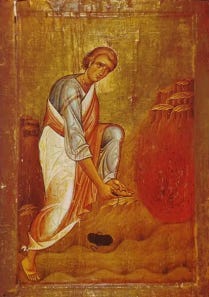
There is no one on Earth who calls themselves a “Christian,” and does not know about the Incarnation of Christ. It is a great mystery, namely that God became Man, which we celebrate this time every year. But, what few know is that Christ Himself appeared on Earth many times even before His Incarnation through His Divine Energies. We can speak of God in two ways – in terms of the Divine Essence and in terms of the Energies. The Essence is completely unknowable in that no one can describe it or see it. The Divine Energies on the other hand are that aspect of God which is knowable, and are characterized by His activities (e.g. working miracles, creating the world) and His attributes (e.g. Absolute Beauty, Absolute Goodness, etc). In the Old Testament, there are many places where God energetically manifests Himself to the Prophets, and indicates that the one who appeared to them is the Divine Person of the Son - the very same Christ who would ultimately be born of the Virgin.
Indeed, one can look to the Burning Bush of Moses (Exodus 3). Concerning it, St. Justin Martyr writes, “When Moses was ordered to go down to Egypt…our Christ conversed with him under the appearance of a fire from a bush” (Apology I, Chapter LXII). Thus, when God appeared to Moses and said that His Name was, “I Am Who I Am,” it was Christ speaking. He appeared in a Pre-Incarnate form – not as a human person, but rather, as a Burning Bush. Likewise, we have the example of the Angel Who wrestled with Jacob. After their bout, Jacob asked His adversary to reveal His name, to which the Angel replied, “Wherefore is it that thou dost ask after my name?” After this had happened, Jacob said of their encounter, “I have seen God face to face” (Gen. 32:29-30). Archimandrite Vassilios Papavassiliou states that the Angel’s withholding of his name from Jacob “is reminiscent of God’s response to Moses on Mt. Sinai.” We see the same behavior in both the Burning Bush and the Angel of the Lord since both are revelations of the same Person – Christ. It is God the Son appearing to both Moses and to Jacob.
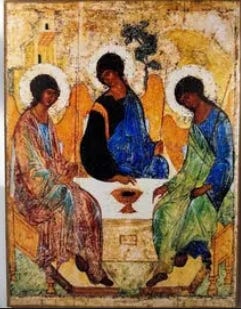
Similarly, the three angels who visited Abraham (Genesis 18) are a theophany of the Son as well as the entire Trinity. On this occasion, Abraham was visited by three angelic men, one of whom he recognized as the Living God and Lord of Creation. It is essential to note that only this particular angel was in fact God appearing to Abraham, whereas the other two were created angels. This is indicated by the text itself, since Abraham only referred to one of the Angels as “the Lord,” signifying His Divinity. Whenever God appears in the Old Testament, it is neither the Person of the Father nor the Holy Spirit who appear - except in the instances where the “Spirit of the Lord” acts. Rather, it is always the Person of the Son. The two angels who were with Christ do symbolize the Trinity, but are not energetic manifestations of the other two Persons. This ties into the Second Commandment God gave to Moses, which stipulates that we can only depict that which we have seen and which has been revealed to us, not that which we cannot see. This why it is forbidden for God the Father to be depicted in iconography, since we have never seen the Father. In iconography, we only ever depict Christ in His human nature, or perhaps as He appeared in one of the Theophanies, because we have only ever seen Him in this manner. We are forbidden from depicting the Divine Nature.
Nevertheless, there are some who claim that the figure of the Ancient of Days, who appears to the Prophet Daniel (Daniel 7) and St. John the Evangelist (in the Book of Revelation), is a manifestation of the Father. This figure appears shining brightly and enshrouded in fire. He is usually portrayed in Orthodox iconography in a manner similar to that of Christ, only with the white beard and the snowy hair of an old man. This led to His being conflated with God the Father, since the Father is depicted in a similar manner in Western pseudo-iconography. The notion that the Ancient of Days is the Father is easily proven false by examining Scripture, the Fathers, and the hymnography of the Church – all of which attest to the Ancient of Days being the Son. Christ sates very clearly: “No one has seen the Father except the one who is from God; only he has seen the Father” (John 6:46) and, elsewhere, “No one has seen God at any time; the only begotten Son Who is in the bosom of the Father, He has made Him known!” (John 1:18). By this, Christ shows that no man has seen God the Father directly, and therefore, we cannot depict Him directly. Christ indicates that He alone is the Living Icon of the Father, and that there is no other image of the Father. Furthermore, St. John Chrysostom states, “But what can I say? For wonder astounds me. The Ancient of Days who sits upon a high and exalted throne is laid in a manger.” St. Athanasius the Great writes, “The Ancient of Days became an infant.” In the Vespers service before the Presentation of the Lord, we sing, “The Ancient of Days, Who of old gave the Law to Moses on Sinai, today is seen as an infant.” Since only the Son was ever incarnate, and not the Father, then it is impossible to say that the Fathers and the hymnography of the Church here are referring to the Ancient of Days as God the Father – they clearly attest to Him being the Son. Therefore, the Ancient of Days cannot be the Father, since the Father has never shown Himself to men, except in the Person of Christ – the Living Icon of the Father – who “has made Him known” (John 1:18).
Now, to return to the Prophets – how do we know that God’s appearance to them was by means of His Divine Energies and why did He appear in this manner? Concerning these two things, Fr. Peter Heers states in one of his lectures on the Mystery of Christ, “that which they saw was not the essence of God, which is invisible and imparticipable, but the Logos of God, still fleshless, who took bodily form appropriate for each instance.” How do we know this is not the Divine Essence? St. John Chrysostom answers this question succinctly, “All of the Theophanies happened by way of condescension, and were not visions of the true essence of God. For if they had seen the nature [i.e. essence] itself, they would not have seen it each in a different way. For the nature is simple, formless, and indescribable, [it] neither sits, nor stands, nor walks. All these things belong to bodies.” Here, St. John proves Christ’s appearance to the Prophets was not by means of the Divine Essence, because the Divine Essence does not preform the activities which take place in the Theophanies. He, with the rest of the Fathers of the Church, maintains that the Essence is simple, and cannot be divided into a multitude of different parts or perform various activities. So then, if God did not appear in His Essence, it must truly have been by means of His Uncreated Energies. Fr. Peter continues, “The fleshless Logos was the bearer of the Trinitarian or Trinal energies, and thus, the Theophanies of the Logos were Trinal manifestations…through the fleshless Logos.” Lay apologist, Jay Dyer, further expounds this point, writing, “Scripture says that both man has seen God face to face, and that no man can see God and live. Rather than being a contradiction, the mystery of the Theophanies of Christ are explained by the Eastern [Orthodox] doctrine of the uncreated energies. When Moses ascended Sinai we are told he ‘saw God,’ and the text explains Moses saw God’s ‘goodness.’ In other words, Moses did not and could never ‘see’ the divine ousia [essence], but rather, was given a vision of divine goodness, one of God’s many operations or energies.”
This interpretation ties back into Exodus 33, where God tells Moses that He will not show him His Face, but His Back and His Glory. This is because it is impossible for Man to behold the Face of God - that is, the Divine Essence - so Moses saw the Divine Person of the Logos manifested through the Back of God, the Divine Energies.
From these examples and citations, we can see that the Son of God was able to appear through the common energy which he shares with the Father and the Holy Spirit. This in turn makes for a revelation not only the Divine Person of the Logos in the Old Testament, but also a revelation of the Trinity. It uncovers the purpose of why God revealed Himself in such a manner –it was for the purpose of prefiguring His Coming and pointing the Prophets to His Incarnation, so that what was prefigured might eventually be done in deed.
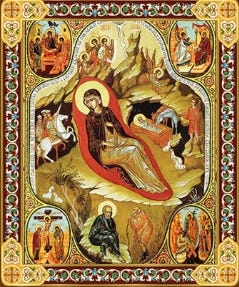
Thus, we see very clearly the many instances where God energetically manifests Himself to the Prophets of the Old Testament, revealing Himself to be the Person of the Son. We see how Christ, throughout the Old Testament, appears to Abraham, Jacob, and Moses by means of His Divine Energies, thus revealing the mystery of His Godhood and at the same time manifesting the doctrine of the Trinity. Although God did not immediately reveal this to Israel, He intended to, and eventually accomplished this endeavor by becoming Incarnate of the Virgin. It is this Incarnation which we will celebrate on this coming Feast of the Nativity - the Incarnation which revealed the fullness of the Truth to Mankind so that we might all glorify the Eternal Logos, together with His Unoriginate Father and His All-Holy, Good, and Life-Creating Spirit, now and ever, and unto the ages of ages. Amen.
Works Cited
· Martyr, St. Justin. “First Apology of Justin.” Orthodox Church Fathers, https://orthodoxchurchfathers.com/fathers/anf01/anf0146.html#TopOfPage. Accessed 11/29/2025
· Papavassiliou, Archm. Vassilios. “The God of the New Testament in the Old Testament (part 1).” Pemptousia, https://pemptousia.com/2017/02/the-god-of-the-new-testament-in-the-old-testament-the-ancient-of-days/. Published 2/17/2017. Accessed 11/29/2025.
· Papavassiliou, Archm. Vassilios. “The God of the New Testament in the Old Testament (part 2).” Pemptousia, https://pemptousia.com/2017/02/the-god-of-the-new-testament-in-the-old-testament-the-hospitality-of-abraham/. Published 2/21/2017. Accessed 11/29/2025.
· Papavassiliou, Archm. Vassilios. “The God of the New Testament in the Old Testament (part 3).” Pemptousia, https://pemptousia.com/2017/04/the-burning-bush/. Published 4/27/2017. Accessed 11/29/2025.
· Papavassiliou, Archm. Vassilios. “The God of the New Testament in the Old Testament (part 4).” Pemptousia, https://pemptousia.com/2017/05/the-god-of-the-new-testament-in-the-old-testament/. Published 5/1/2017. Accessed 11/29/2025.
· Papavassiliou, Archm. Vassilios. “The God of the New Testament in the Old Testament (part 5).” Pemptousia, https://pemptousia.com/2017/05/the-god-of-the-new-testament-in-the-old-testament-part-5/. Published 5/4/2017. Accessed 11/29/2025.
· Dyer, Jay. “The Western Loss of Theophanies, Descent & Recapitulation of Christ.” Jay’s Analysis, https://jaysanalysis.com/the-western-loss-of-theophanies-descent-recapitulation-of-christ/. Published 9/11/2018. Accessed 11/29/2025.
· Heers, Fr. Peter. “The Son as Creator – The Mystery of Christ: An Athonite Catechism (Lesson 3).” Orthodox Ethos,
. Published 2/15/2024. Accessed 11/29/2025.